

Featured Resources
The Ada Center’s mission is to help colleges and universities use technology in ways that strengthen student success and expand pathways to economic mobility. As part of that work, we develop and share open-access resources informed by ongoing partnerships with institutions, state systems, foundations, and national organizations.
Our current work is increasingly focused on helping institutional leaders navigate the rapidly evolving AI landscape with clarity, practicality, and a strong focus on student outcomes.
Student Success Technology Diagnostic
Team Tool
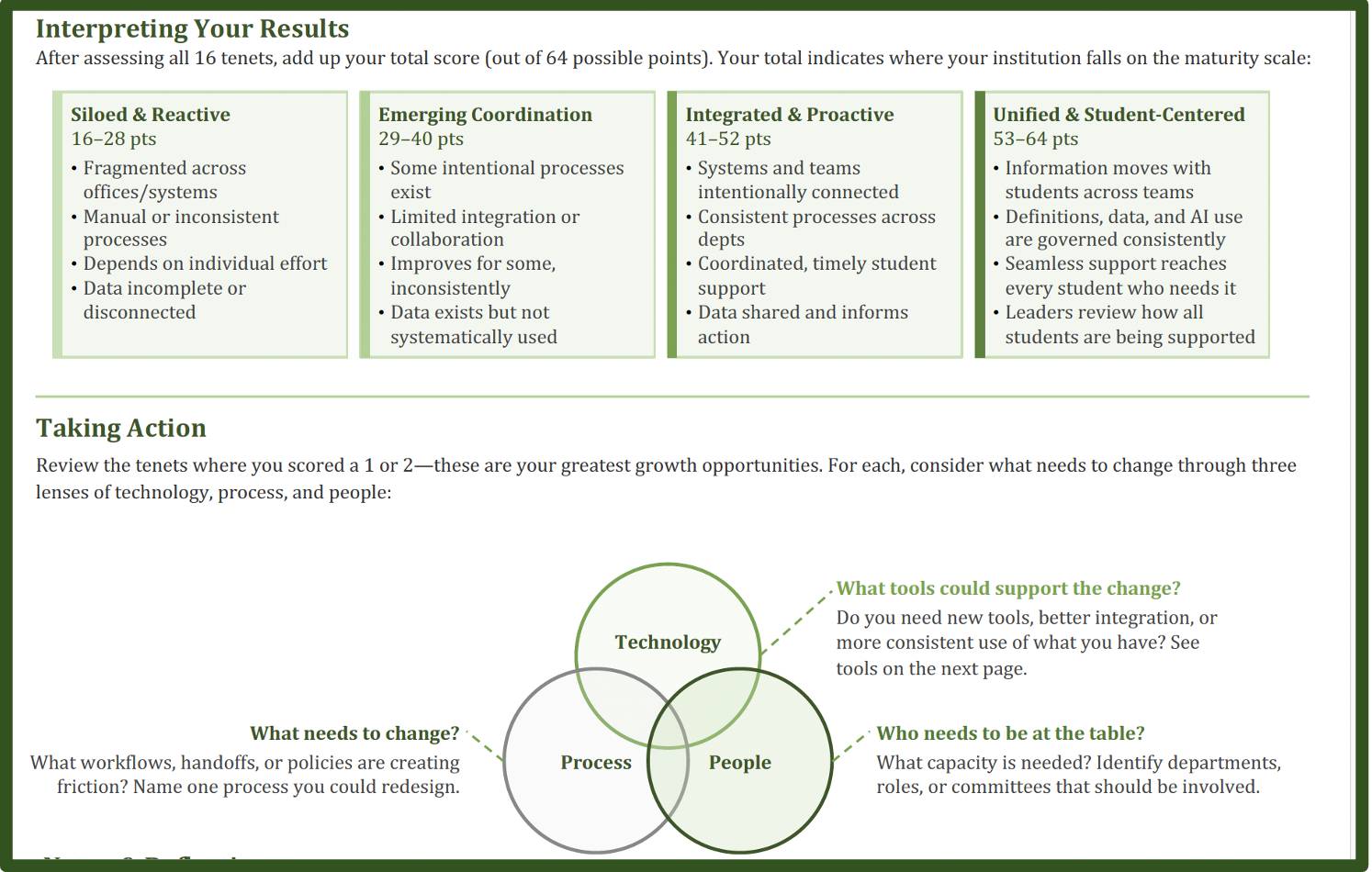
Drawing on The Ada Center’s research and implementation experience, this diagnostic identifies 16 tenets of a healthy student success technology ecosystem. It helps institutional teams assess current practice, identify strengths and gaps, and prioritize improvements across five phases of the student journey.
Through this resource, institutional teams will:
Assess the health of their student success technology ecosystem across 16 core tenets
Identify opportunities to strengthen technology, data, and organizational practices
Prioritize next steps, key stakeholders, and enabling technologies to support continuous improvement
This tool was developed by The Ada Center with generous support from Ascendium Education Philanthropy and thought partnership with the Ohio Success Center.
Curriculum and Resources
Making Sense of Student Success Technology Through Five Practical Learning Modules

Developed in 2023, this five-module learning series helps higher education leaders and practitioners navigate the complex landscape of student success technology. Informed by The Ada Center’s work with hundreds of broad-access colleges and universities, it translates complex technology concepts into practical, actionable guidance. Each module includes planning tools, discussion guides, facilitated activities, and research-based resources. Together, these materials help cross-functional teams build shared understanding, strengthen technology strategy, and move from learning to action.
These resources were developed by The Ada Center in partnership with Complete College America and were compiled with generous funding from the Gates Foundation. The Advising Success Network is a roll-out partner and project champion for the curriculum.
Report and Video
Practical Insights for Leaders Advancing Holistic Student Support
For many years, technology and student success efforts operated on parallel tracks. IT teams managed systems while student success leaders focused on programs, services, and strategy. Today, those worlds are increasingly intertwined.
Nowhere is this more evident than in Holistic Student Support (HSS), where delivering coordinated, personalized support depends not only on people and practice, but also on the technology and data infrastructure that connects them.
Drawing on more than seven years of work with California Community Colleges, this report provides leaders with:
An overview of the evolving HSS technology landscape in California and nationally
Insights into the technology tools, challenges, and priorities of California colleges, including case studies and technology maps from HSS Implementation Network institutions
Practical recommendations and resources to help governing bodies, supporting organizations, and colleges strengthen technology-enabled student support
This report was developed by The Ada Center with input from Phase Two Advisory and generous support from College Futures Foundation (CFF). For more on our work in California, please visit our Spotlight on CA page.
Technology Mishaps Map
Diagnostic Tool for Assessing and Correcting Off-Track Implementations
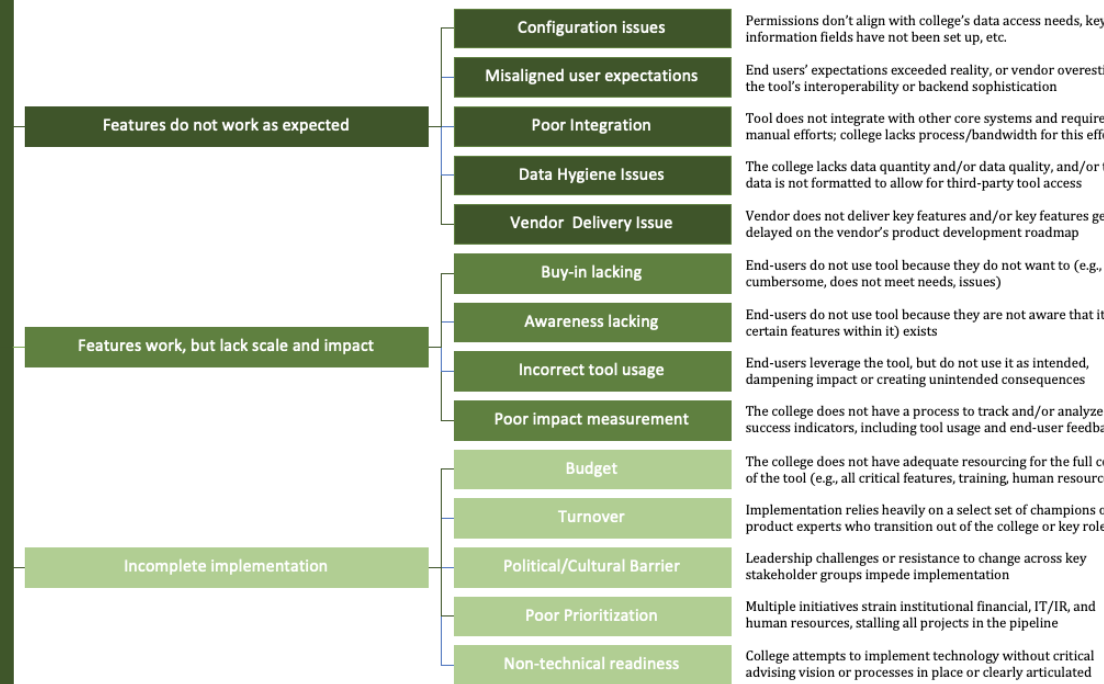
Technology implementations can go off track for many different reasons, and the right solution depends on understanding the specific challenges at play. So where do we start?
The answer is with accurate, targeted diagnostics.
The Mishaps Map helps organizations identify why a technology implementation is struggling by answering two fundamental questions:
What, specifically, is going wrong?
Why are these challenges occurring?
Once those root causes are clear, organizations can move beyond guesswork and make strategic decisions about the interventions, supports, and next steps most likely to get the implementation back on track.
CRM 101 Guide
Making Sense of CRMs in Higher Education
The term CRM (Customer Relationship Management) is used to describe dozens of technology products, product categories, and platform capabilities. As a result, colleges often struggle to establish a shared understanding internally while navigating an increasingly complex CRM marketplace.
Based on more than 50 interviews with higher education practitioners, researchers, technology leaders, and CRM vendors, this report provides a practical guide to the CRM landscape in higher education. It explains what CRMs are, what they can (and cannot) do, how different products compare, and how institutions can prepare for successful CRM adoption.
Playbook for Institution Leaders
Advising Technology Procurement and Planning
Based on research from over 40 institutions that have implemented a wide range of advising technology tools, the Playbook provides step-by-step guidance for leaders and teams seeking to procure new advising tools or hoping to get an ongoing technology-supported effort back on-track.
The Playbook was published in 2019 through generous support from the Gates Foundation.
Decision Support Framework
Navigating Student Success Technology
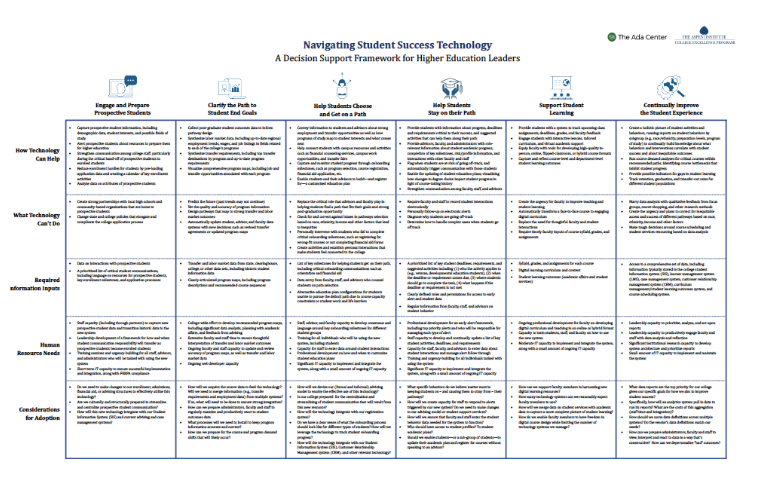
Originally developed by The Ada Center and the Aspen Institute College Excellence Program in 2017, this framework helped many institutions better understand the rapidly evolving student success software market. The resource includes a high-level framework poster and companion toolkit that explain key technology capabilities, the organizational and technical foundations needed to support them, and considerations for evaluating solutions.
While many of the underlying concepts remain relevant, the technology landscape has evolved significantly. The Ada Center plans to release a fully updated edition in 2027 that reflects advances in artificial intelligence, data integration, and the changing student success technology ecosystem.
Software Evaluation Guides
Questions to Ask Before Purchasing a Case Management, Degree Planning, or Predictive Analytics Tool
Developed for Achieving the Dream's Integrated Planning and Student Support Toolkit in 2018, this resource provides college leaders with an organized checklist of considerations when purchasing three distinct categories of software tools: case management and advising; degree planning; and predictive analytics. For each of these software categories, the Ada Center provides general commentary on the pricing, integration, and implementation experiences drawn from colleges that have purchased tools from a variety of vendors.
Report on Scheduling Systems
Lessons from a Statewide Software Implementation
In 2016, the Ohio Association of Community Colleges (OACC) received funding through the Ohio Department of Higher Education’s Innovation Grant to help community colleges use data analytics to improve course scheduling and resource allocation. Eighteen colleges participated in this multi-year initiative, with The Ada Center serving as the qualitative evaluation partner.
Drawing on implementation experiences across participating colleges, this report explores the opportunities, challenges, and lessons learned from adopting course scheduling technologies. It offers practical insights for state systems, higher education organizations, and institutional leaders considering similar technology investments.